
This is not another “try harder” article.
In fact, This is mindful eating vs dieting, explained with science, psychology, humor, and a small dose of mind-reading (yes, I know what you’re thinking right now).
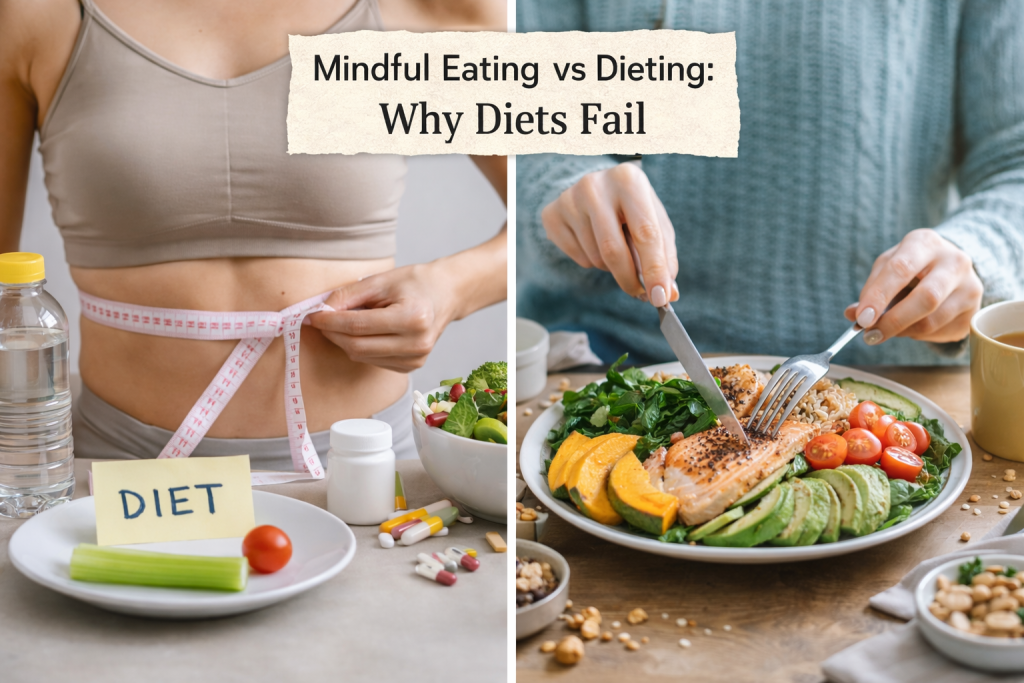
Let’s be honest.
If diets worked long-term, gyms would be museums and “summer body” ads would be illegal due to lack of relevance.
Yet here we are — smarter, busier, more stressed — still blaming ourselves because a PDF meal plan failed again.
So let’s clear the fog once and for all.
What is Mindful Eating vs Dieting: The Brutal Truth – Diets Don’t Fail…They Finish
First, What is Mindful Eating?! Mindful eating is paying full, non-judgmental attention to your food and eating experience—your senses, thoughts, feelings, and physical hunger/fullness cues—to be present, savor food, and build a healthier relationship with eating, often involving slowing down, minimizing distractions, and noticing how food affects your body.
Inded, diets are designed like action movies:
- Intense start
- Dramatic rules
- Short duration
- Predictable ending
Stat that stings:
👉 Over 95% of diets fail within 1–5 years, and two-thirds of people regain more weight than they lost. Not because they’re weak — but because biology always wins. Here comes the body fat calculator!
Your brain hears “diet” and translates it as:
“Food shortage detected. Activate survival mode.”
And survival mode doesn’t care about your beach plans.
Why Dieting Feels Good… Until It Doesn’t
At first, dieting gives you:
- Control
- Praise
- Fast results
- That smug “I’m being healthy” feeling
But meanwhile, behind the scenes:
- Hunger hormones increase
- Metabolism slows
- Obsession with food grows
- Guilt becomes a side dish
Eventually, one cookie becomes:
“I’ve ruined everything, might as well eat the whole box.”
And boom — diet failure narrative unlocked.
Mindful Eating vs Dieting: The Core Difference
Let’s simplify it.
Dieting says:
- “Follow rules”
- “Ignore hunger”
- “Good foods vs bad foods”
- “You failed if you ate cake”
Mindful eating says:
- “Listen first”
- “Respect hunger”
- “Food is neutral”
- “One meal never defines you”
Dieting controls food.
Mindful eating rebuilds your relationship with food.
That difference changes everything.
Mind Reading Moment (Yes, This Is You)
Right now you’re thinking one of these:
- “This sounds nice, but I need discipline.”
- “Will I just eat pizza forever?”
- “I’ve tried intuitive eating… didn’t work.”
Totally normal.
Also totally predictable.
Because dieting trains you to distrust yourself.
Mindful eating retrains you to trust again — slowly, safely, sustainably.
Why Diets Fail Long-Term (Science, Not Motivation Posters)
Here’s what research consistently shows:
- Restriction increases binge behavior
- Rigid rules increase food obsession
- Weight cycling increases health risks
- Shame reduces long-term behavior change
Translation?
The harder you diet, the more your body pushes back.
Mindful eating works with biology, not against it.
What Mindful Eating Actually Looks Like (No Incense Required)
Mindful eating is not:
- Eating slowly like a monk
- Chewing each bite 47 times
- Being “perfectly present” every meal
It is:
- Noticing hunger before it becomes rage
- Eating without multitasking (sometimes)
- Stopping when satisfied — not stuffed
- Choosing food that feels good after, not just during
And yes — cake is allowed. Ironically, when food is allowed, it loses its power.
Mindful Eating vs Dieting: The Mediterranean Plot Twist (Hello, Spain)
Here’s the funny part.
Spain already lives many mindful eating principles:
- Shared meals
- Real food
- Slower pace
- Less moral panic about eating
That’s why the Mediterranean lifestyle consistently ranks among the healthiest in the world — not because of calorie counting, but because of relationship with food.
It’s mindful eating… without calling it mindful eating.
The Hidden Benefit No One Talks About
Weight loss is not the first win.
People practicing mindful eating report:
- Better digestion
- Fewer cravings
- Less anxiety around food
- More stable energy
- Improved mental health
Weight changes often happen — but as a side effect, not a punishment.
And side effects are easier to live with.
Common Trap: Turning Mindful Eating Into Another Diet
Yes, it happens.
Warning signs:
- “I’m failing at mindful eating”
- “I should be more intuitive”
- “I ate emotionally — I did it wrong”
Congratulations — you accidentally created Diet 2.0.
Mindful eating is a practice, not a performance.
So… Which One Wins?
Mindful eating vs dieting is not even a fair fight.
Dieting:
- Short-term
- Rule-based
- Shame-driven
- High relapse rate
Mindful eating:
- Long-term
- Body-based
- Compassion-driven
- Sustainable
One fights your biology.
The other partners with it.
The Future of Eating (Spoiler: Diets Are Fading)
As burnout rises and ultra-processed food dominates shelves, people are done with punishment-based health.
The future belongs to:
- Awareness over restriction
- Skills over rules
- Relationship over control
Mindful eating isn’t trendy.
It’s the correction.
Quick FAQ
Is mindful eating good for weight loss?
Yes — but indirectly. It improves behaviors that support natural, sustainable weight regulation.
Can mindful eating replace dieting?
For most people, yes — especially those stuck in diet cycles.
Does mindful eating work for busy people?
Absolutely. It’s about moments of awareness, not perfection.
Final Thought (Read This Twice)
You don’t need a new diet.
You need a new conversation with your body. And unlike diets — that conversation doesn’t end in regret